
Service Times
Regular weekly timetable
Mon
- –
Tue
- –
Wed
- 13:00 Eucharist
Thu
- –
Fri
- 13:00 Eucharist
Sat
- –
Sun
- 10:00 Sung Eucharist
- 15:30 Choral Evensong
Times can change over Christmas and Easter and during the summer; check with the church before travelling.
About St Anne's Cathedral (Belfast Cathedral)
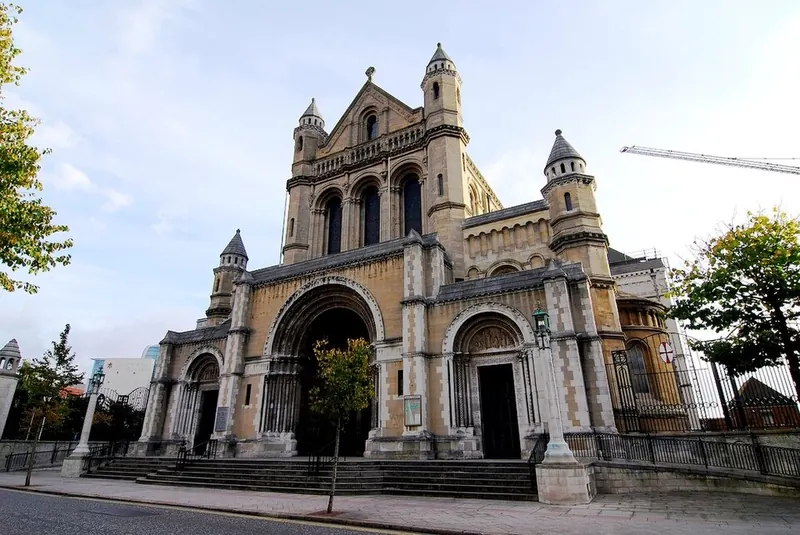
St Anne's Cathedral, known as Belfast Cathedral, is an impressive Romanesque building in the heart of Belfast's Cathedral Quarter. The Spire of Hope, added in 2007, rises 40 metres above the roof. The cathedral contains the tomb of Edward Carson.
History
The site in Donegall Street originally held a smaller church in Classical style, a gift to the town of Belfast by its landlord, Lord Donegall. That parish church was consecrated in 1776 and named St Anne's, after the mother of the Virgin Mary. The cathedral's own history notes that Lord Donegall's wife was also called Anne, which probably determined the choice of name.
The project to build a cathedral for Belfast was launched in 1895. Two Belfast architects were appointed, Thomas Drew, who provided the plans, and WH Lynn. The foundation stone was laid on 6 September 1899 and building began around the old church, which continued in use for services until the end of 1903, by which time the tower of the older St Anne's had been dismantled. The congregation then worshipped in the Clarence Place Hall in May Street for five months. The nave, the first part of the new building to be constructed, was consecrated on 2 June 1904.
Construction continued in sections for nearly 80 years: the crypt and foundations for a proposed crossing tower in 1922-24, the west front in 1925-27, the baptistery in 1928, the Chapel of the Holy Spirit in 1932, the apse and ambulatory in 1959 and the transepts in 1974 and 1981. A temporary brick chancel served until the east end was completed. The stainless steel Spire of Hope was lowered into place in 2007.
The building
The cathedral is cruciform and basilican in form, in a Romanesque style characterised by semi-circular arches. The ground beneath it is a bed of soft clay known as sleech, and wooden piles 50 feet long were driven through it to a firmer stratum to support the walls and pillars of the nave. The cathedral's history gives this ground condition as the reason the building carries a light-weight spire rather than a heavy central tower.
A labyrinth, an image of the journey of life, is set into the flooring at the entrance. Each of the nave pillars represents an aspect of life in the province: science, the linen industry, healing, agriculture and music on the north side; theology, shipbuilding, freemasonry, the arts and womanhood on the south. The half columns, or responds, represent the cardinal virtues of courage, justice, temperance and wisdom, and an archangel stands in each corner of the nave: Gabriel, Michael, Raphael and Uriel.
Notable features
The Good Samaritan Window is the only feature of the old St Anne's Church to remain in the present cathedral. The nave windows depict major figures from the Old Testament, the west windows take temple-building as their subject and the ambulatory windows represent five of St Paul's fruits of the spirit. Mosaics at the west end, by Gertrude and Margaret Martin, represent Creation, St Patrick's return to Ireland and Isaiah's vision in the Temple. Above the West Door is a memorial to choir men who lost their lives in the war of 1914-1918.
Other items include the tomb of Lord Carson, the Titanic Pall, the State Seats, the Bishops' thrones and the reredos by Rosamond Praeger, titled 'As the Shadow of a great rock'. The Treasury holds a selection of the cathedral's silver, including pieces from the former parish church in High Street, and the Military Chapel holds the Majury Prayer Book and regimental colours. The 1914-1918 War Memorial Lectern and kneelers worked by the Tapestry Guild are also in the building.
Notable people
Thomas Drew and WH Lynn, both Belfast men, were the architects of the cathedral, Drew providing the plans. The earlier parish church on the site was given to the town by Lord Donegall, and Lord Carson is entombed in the present building. The sculptors Morris Harding, Rosamond Praeger and Esmond Burton were among the artists responsible for its decorative elements. The portrait heads above the nave pillars depict distinguished churchmen and one woman, the hymn-writer Mrs CF Alexander.
Clergy
- Dean Very Rev Stephen Forde
Location & contact
Address
Donegall Street, Belfast City Centre, Antrim, BT1 2HB
Phone
+44 28 9032 8332Website
www.belfastcathedral.org