
Service Times
Regular weekly timetable
Mon
- –
Tue
- –
Wed
- –
Thu
- –
Fri
- –
Sat
- –
Sun
- 09:45
See service times at the other church in Dublin 4 →
Times can change over Christmas and Easter and during the summer; check with the church before travelling.
About St Andrew's Presbyterian Church
St Andrew's Presbyterian Church is a congregation of the Presbyterian Church in Ireland in Dublin 4, County Dublin.
History
Presbyterians living in the Blackrock area met in the Town Hall on 29 July 1894 to consider founding a congregation. A deputation was appointed to the Mission Board, which made a grant in October 1894 and placed a committee of ministers in charge, and the group continued to meet for worship each Sunday in the town hall, paying £4 a year to the caretaker for making the premises available. The General Assembly sanctioned the organisation of a congregation in June 1895, and it came into being as Blackrock Presbyterian Church. The name St Andrew's was suggested by Mr Hewat at a meeting on 29 November 1895. The first minister, James Snowdon, was ordained at York Road, Kingstown on 10 October 1895 and served the congregation for 41 years until his death on 20 January 1936.
The premises known as Albion House, Merrion Avenue, on the site of the present church, were bought under a contract signed on 19 November 1895 for £750, the purchase being completed on 21 March 1896 after a donation of £800 from Hewat. Murray and Forrester of London were appointed architects and the building contract went to P. Caulfield of Booterstown, whose tender for the church with a cheaper temporary hall came to £3760.12.6. The foundation stone was laid on 29 October 1898 by Mrs Hewat and the first service was held on 5 February 1899. Hewat died within two years of the opening and bequeathed £2000, which cleared the debt on the church and allowed the manse to be built in 1902/3.
The building
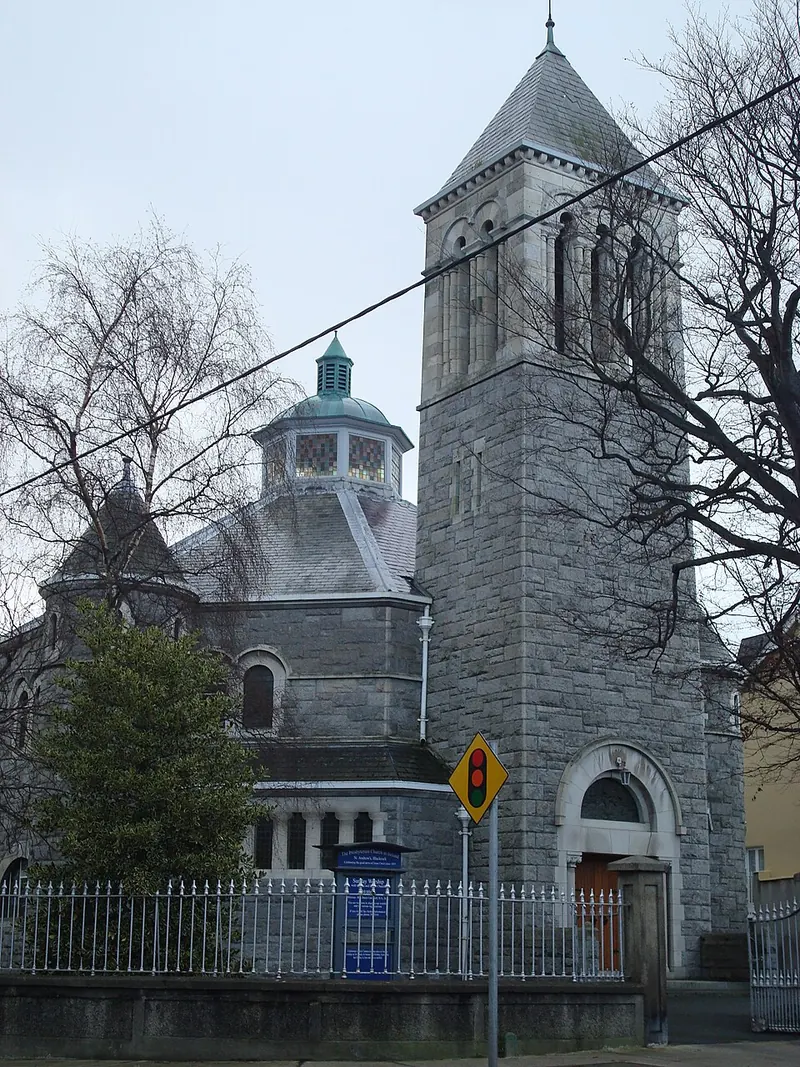
The church is octagonal in shape with a tower at the front. The floor originally sloped from the two side doors down the side aisles, the pulpit stood in the arched recess and the communion table occupied a central position on a raised platform in front of it.
In the early years the music was provided by an American organ, a type of harmonium. This was not considered suitable, and Andrew Carnegie agreed to meet half the cost of a replacement on condition that the congregation raised the other half. The new organ, which cost over £900 in all, was installed in the alcove during April and May 1912, the pulpit was moved to one side and the church reopened on 2 June 1912. By 1908 the congregation had decided to build an iron hall at the rear of the church at a cost of £168.10.9; it served until the present hall was built in 1959.
Notable features
The foundation stone laid in 1898 is in the vestibule. The communion table and baptismal font were reported as gifts to the congregation the day before the first service in February 1899 and are still in the church. A memorial tablet bearing the names of six members of the congregation who died during the Great War was unveiled on 15 January 1922.
Clergy
- Minister Rev Andrew Gill
Location & contact
Address
18 Mount Merrion Avenue, Blackrock, Dublin 4, Dublin, A94 F5P6
Phone
+353 1 288 2314Website
www.standrewschurchblackrock.ie