
Service Times
Regular weekly timetable
Mon
- –
Tue
- –
Wed
- –
Thu
- –
Fri
- –
Sat
- –
Sun
- 09:00 Holy Communion
- 10:00 Hilden Service
- 11:00 Morning Prayer
See service times at the other church in Lambeg →
Times can change over Christmas and Easter and during the summer; check with the church before travelling.
About Lambeg
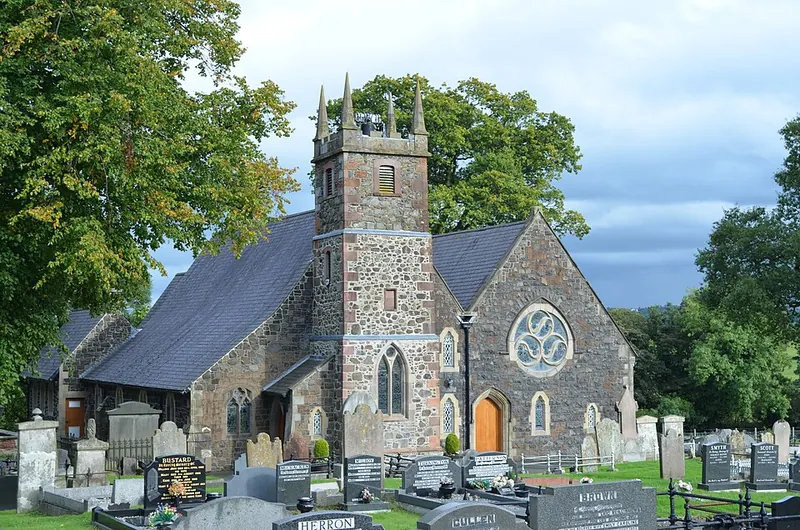
Lambeg is a Church of Ireland church in Lambeg, County Antrim. It is in the Diocese of Connor.
History
The first definite mention of a church here is on a map of Ulster dated 1598, held by the British Museum, which marks Lambeg Church. The parish's own history records that historians place a place of worship on the site possibly as far back as 1306, with monastic foundations in the vicinity from at least the fifteenth century. The original small church is reported to have been in a ruinous condition before the Civil Wars that ended the reign of Charles I in 1649. In 1657 the parish of Lambeg became part of the parish of Blaris, and until the new church was built its affairs were the responsibility of the clergy in Lisburn.
On 25 September 1737 Francis Hutchinson, Bishop of Down and Connor, consecrated the Chapel of Lambeg. It was an oblong building 60 feet long and 18.5 feet wide, seating fewer than 200. The church was completely rebuilt in 1849, apart from the tower, to a design by the architect Butterfield, the growth of the linen industry having left the older building able to hold little more than a fifth of the parishioners. Shortly before the disestablishment of the Church of Ireland in 1870 a south aisle was added, bringing the seating capacity to 480. The east end of that aisle served as a chancel until 1902, when the old chancel was brought back into use.
The building
The tower is the oldest part of the present building, surviving from the chapel of 1737, and was then surmounted by a wooden cupola with a weathercock. The design of 1849 opened the tower into the west end of the church as a baptistry. An organ by Conacher was erected at the east end of the south aisle in 1903 at a cost of £418. The bell was bought from Ballymena parish in 1895 and had been cast in 1866; it weighs 12cwt.
Electricity was installed in 1933 and the interior was redecorated in 1949. The roof was re-slated in 1967, with repairs to the fabric, new lighting and redecoration, at a cost of £8,600. A robing room adjoining the chancel was built in 1969 and the stonework was renovated in 1976. Work on the rainwater disposal system of the tower began in April 2016, after repeated attempts to stop moisture entering the baptistery had failed, supported by a £20,000 award from the Listed Places of Worship Roof Repair Fund.
Notable features
The churchyard occupies an ancient site, at one time held by a thirteenth-century Franciscan friary, and its south side is referred to as the Nun's Garden. The oldest gravestone is dated 1626 and reads "Here lyeth the body of Margaret Wilson, wife of Donnell Savage, who departed this life the 24 April 1626". Inscriptions from the older tombstones, including some since lost, were recorded by William Cassidy in 1937.
Buried here are members of the Wolfenden, Barbour and Richardson families, who were involved in the linen and paper industries at Lambeg and Lisburn. The Wolfenden enclosure is headed by a red sandstone monument bearing the date 1693, and a stone within it carries the family's armorial bearings. Helen Barbour married Thomas Andrews, chief designer of the Titanic, in the church in June 1908; Andrews was lost with the ship. The churchyard also holds the graves of Methodist and Roman Catholic clergy who served in the Lisburn area, among them Rev. John Bredin, who died in 1819, and Rev. John Mullan, parish priest of Derriaghy, who died in 1772. A gift of land from Sir Milne Barbour extended the churchyard by over one and a half acres in 1921.
Location & contact
Address
5 Church Hill, Lambeg, Antrim
Website
lambeg.connor.anglican.org/